Guide · Daily planning
How to plan tomorrow for your team in ten minutes.
A short evening routine that any small team can use, with or without special software. It catches most of tomorrow’s problems while they are still cheap to fix.
Why the evening, not the morning
Planning in the morning feels natural, but it competes with everything else the morning brings: messages that arrived overnight, a client call, a colleague asking for help. Planning at the end of the day has three advantages. You still remember what happened today. The people you depend on are still around to answer a question. And when you arrive tomorrow, the first decision is already made.
The ancient Stoics had a version of this habit. Seneca described reviewing each day in the evening, and Marcus Aurelius wrote about preparing himself each morning for what the day would bring. You do not need philosophy to use it, but the idea has lasted for a reason.
The routine, step by step
Each person does steps one to four on their own, in about five minutes. A team lead then does step five.
1. Close today
Look at what you planned for today. For each task that is not finished, make a deliberate choice: move it to tomorrow, put it back into the week, drop it, or note that you are staying late to finish it. Do not let it silently roll over. If a task has rolled over three times, stop and ask why; it is probably blocked or unclear.
2. Start from the week
If your team plans the week (see the weekly planning guide), start tomorrow’s list from it. If the week says you are on the website project tomorrow, that project’s next tasks go on the list first. Add anything your lead asked you to pick up.
3. Order the list and estimate
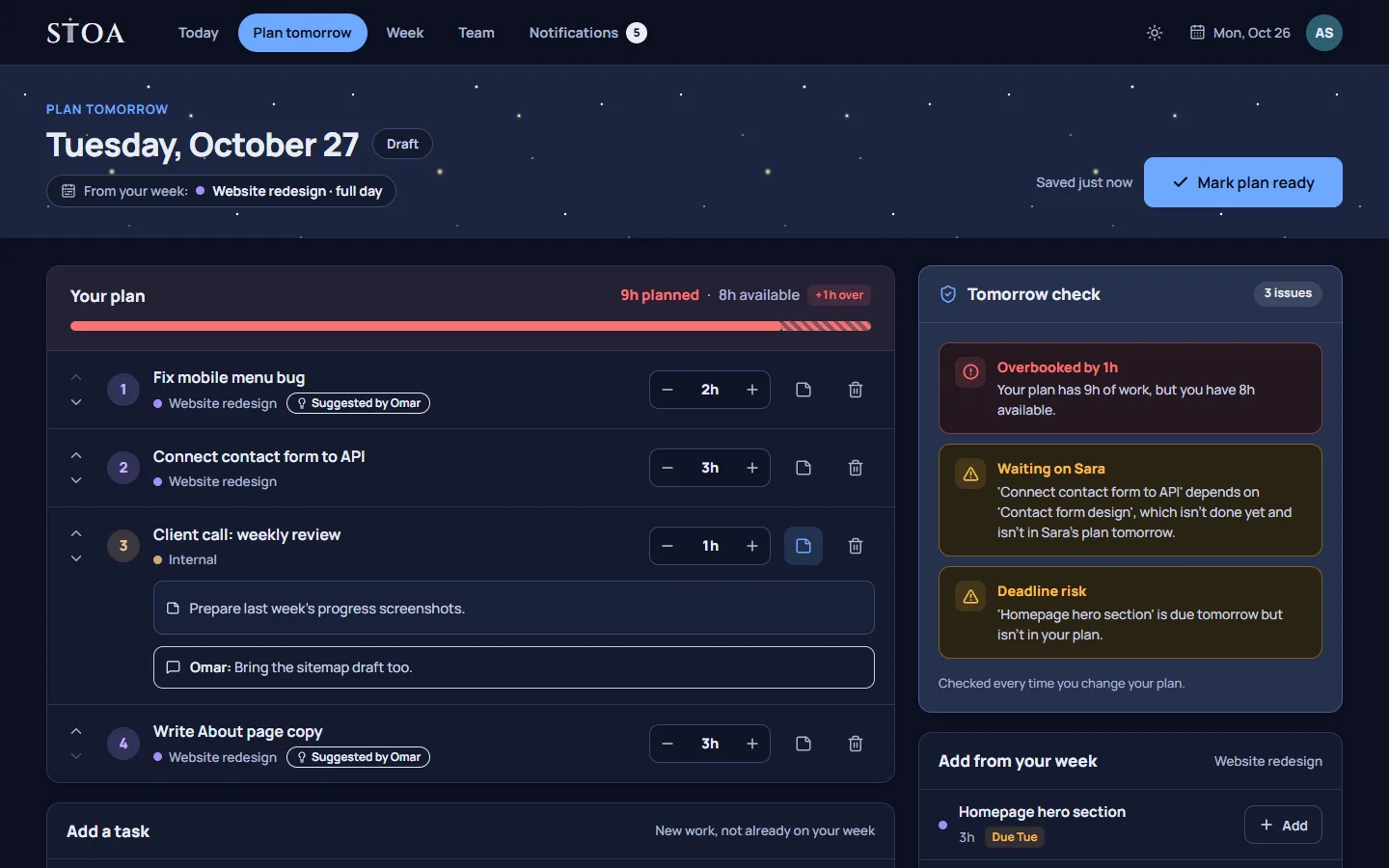
Put the tasks in the order you will do them, and write a rough estimate in hours next to each one. Rough is fine: “2h”, “half a day”. Add the numbers. If the total is longer than your working day, something has to move now, not at 4 PM tomorrow.
4. Check your handoffs
For each task, ask two questions:
- Am I waiting on anyone? If a task needs someone else’s work first, is that work done, or in their plan early enough tomorrow?
- Is anyone waiting on me? If a colleague needs something from you, is it near the top of your list?
Also check for time off. If a task needs a colleague who is away tomorrow, move it or find someone else now.
5. The lead’s two-minute look
Once everyone has planned, the lead reads the team’s plans side by side. You are looking for a short list of things:
- anyone who has not planned yet;
- anyone whose day is longer than their working hours;
- a handoff where one person’s plan does not match another’s;
- a deadline coming up that is not in anyone’s plan.
Fix each one with a short message or a suggestion. Resist the urge to rewrite people’s plans; they know their own work best. A good suggestion says what and why, and leaves the person free to say no.
Doing it with a spreadsheet
You can run this routine with a shared spreadsheet: one tab per day, one column per person, a row per task with an hour estimate, and a total at the bottom. It works for three or four people. It gets harder as the team grows, because the handoff checks are manual: someone has to read every column and spot that Sam’s second task depends on Ahmed’s fourth.
Doing it in Stoa
Stoa was built around this routine. After a time you choose, each person is prompted to plan tomorrow. Their plan is pre-filled from the week and from their lead’s suggestions. The tomorrow check runs steps three and four automatically: it flags an overbooked day, a task waiting on someone else, a deadline at risk, and a task planned with someone who is off. Leaders see everyone’s plan on team tomorrow, and the end-of-day review handles step one.
Common mistakes
- Planning every minute. Leave room. A plan at 100% of the day will be wrong by 10 AM.
- Skipping the close. Without step one, unfinished work piles up invisibly.
- Turning it into a report. The plan is for doing the work, not for proving hours. Keep it light.
- Doing it alone. The real value is in comparing plans. One person planning perfectly does not fix a handoff.
Try the routine for one week. If it helps and you want the checks done for you, Stoa has a 14-day free trial; the pricing page lists the plans.
Plan tomorrow tonight, starting this week.
14 days free, no card needed. One price covers the whole team, from 2 to 30 people.